Erin Fulton presented this paper at the 2020 annual conference of the Society for American Music.
Having once focused exclusively on the tunebook repertoire, musicologists have developed an increasingly nuanced understanding of sacred music dissemination in the eighteenth- and nineteenth-century United States. Print and manuscript, oral and literate, Northern and Southern are no longer viewed as simple dichotomies. Yet the music of the Caster family account book—copied in western New York in the late 1850s—suggests a still-overlooked mechanic of sacred music dissemination: memorization. Done for both practical and ideological reasons, memorization practices help explain musicians’ knowledge of repertoire that seems chronologically or geographically “distant” from them, as well as deviations from other known sources. The Caster manuscript is an ideal laboratory for studying memorization, since it is known to have been written from memory and records Ira Castor’s exposure—over his considerable lifetime—to a range of sacred music he considered worth remembering.
Richard Crawford and David P. McKay were among the first scholars to challenge the assumption that early American sacred music was disseminated primarily via print. Their study of the Sukey Heath manuscript demonstrated that 1) even sacred music in learned styles might circulate in manuscript prior to being printed and that 2) variance between print and manuscript attestations was both widespread and pronounced. Since then, bibliographical control over manuscript sources has greatly increased with the completion of SWASMIS and the American Vernacular Music Manuscripts database, and further studies of sacred music manuscripts have been written. Scholars have tended to express frustration when clear corroborative sources for repertoire cannot be identified, or when such sources seem unlikely to have been available to the manuscript’s creator. None of these articles have suggested memorization as an explanation for the appearance of “unlikely” music or the spanning of oral and print repertoires.
Literature on Manuscript Sacred Music:
- Barnett, Joshua Rush. “The Brandstetter Tunebook: Shape-Note Dissemination and the Germans of Western Maryland.” American Music 33, no. 2 (Summer 2015): 176–218.
- Crawford, Richard, and David P. McKay. “Music in Manuscript: A Massachusetts Tune-book of 1782.” Proceedings of the American Antiquarian Society 84, no. 1 (January 1974): 43–94.
- Marini, Stephen A. The Cashaway Psalmody: Transatlantic Religion and Music in Colonial Carolina. Urbana: University of Illinois Press: 2020.
- Music, David W. “The John Beatty Manuscript: An Eighteenth-Century American Tunebook.” The Hymn 63, no. 2 (Spring 2012): 27–38.
- ———. “The Meyer Manuscript: An 18th-Century American Tunebook.” Current Musicology 1980: 31–40.
- Vogan, Nancy F. “The Musical Traditions of the Planters and ‘Mary Miller Her Book.’” In Making Adjustments: Change and Continuity in Planter Nova Scotia, 1759–1800: 247–252. Edited by Margaret Conrad. Frederickton: Acadiensis Press, 1991.
- ———. “The Robert Moor Tunebook and Musical Culture in Eighteenth-Century Nova Scotia.” In Planter Links: Community and Culture in Colonial Nova Scotia: 154–164. Edited by Margaret Conrad and Barry Moody. Fredericton: Acadiensis Press, 2001.
- Wolf, Edward C. “The Convivial Side of Scottish Psalm Tunes.” American Music 14, no. 2 (Summer 1996): 141–160.
Memorization has occasionally received mention in historical research on music education, which confirms that rote learning—both of tunes and of music theory principles—was an vital element in the “sound-before-sight” pedagogy popularized during the mid-nineteenth-century. Linda Davenport has uncovered a description of a 1780s singing school that confirms that memorization was also practiced in that era, even though eighteenth-century tunebooks rarely mention it. Large-scale studies of music memorization have come mostly from cognitive frameworks and focused on non-literate traditions. The presumption has often been that people who were able to read (or able to read music) would lack the need, interest, or even capacity for memorizing repertoire. Psychologist David Rubin has stated that “The transmission of oral traditions is remarkable to the modern, literate observer. Songs, stories, and poems are kept in stable form in memory for centuries without the use of writing, whereas the literate observer has trouble remembering what happened yesterday without notes.”1 Yet scholarship on nineteenth-century music manuscripts confirms what might seem common-sensical: despite the strong cultural association we now have between memorization and orality, most manuscripts were compiled by middle-class, literate people who, like Ira Caster, enjoyed some formal education and the leisure time in which to pursue musical interests.
The Caster family account book is owned by Laura and Chris Densmore. Chris, a historian of Quakerism, was working on a study of nineteenth-century account books when he encountered the manuscript at a Syracuse antique auction. The Casters in question were descendants of a John Custover who immigrated from France to Connecticut in the mid-seventeenth century. (For clarity, I refer to various members by either first or full name.) The account book was first used by his son. Born in New London, John DeCastorer moved to New York around the time of his marriage, following members of his wife’s family to Hillsdale, only three miles from the Massachusetts border. They uprooted again to south-central New York, where Ira—the second-youngest of eight siblings—was most likely born. Finally, they settled on a permanent basis at the eastern end of Lake Ontario, arriving in Oswego County sometime between 1786 and 1792. The first entries in the account book, dated to 1796, reveal the family’s farming and shoemaking activities. Around the turn of the century, they built a sawmill on what is now called “Castor Pond,” on the Salmon River two miles above its confluence with the Mad. Ira is first mentioned in the account book in 1807, when he would have been nineteen or twenty years old.
Movements of the Caster Family:
| John Custover (ca. 1725-1747/8) Born in France ca. 1725 Living in New London, CT by 1744, when he married Lucretia Richards Died in New London in late 1747 or early 1748 |
| John DeCastorer (1748-1835) Born in New London, CT on 16 July 1748 (after his father’s death) Removed to Hillsdale, NY, ca. 1770, shortly after marriage to Anne Calkins Removed to Spencertown, NY in 1773 Removed to Oswego County, NY (area later incorporated as “Redfield”) by 1792 Removed to Ellisburg, NY by 1831, where he died in 1835 |
| Ira Caster (1787-1866) Born 22 May 1787, most likely in Spencertown, NY Married Chloe Loomis in Redfield, NY, on 28 January 1812 Removed to Ellisburg, NY, ca. 1831, where he died on 2 April 1866 |
First Mention in the Account Book of Ira Caster:
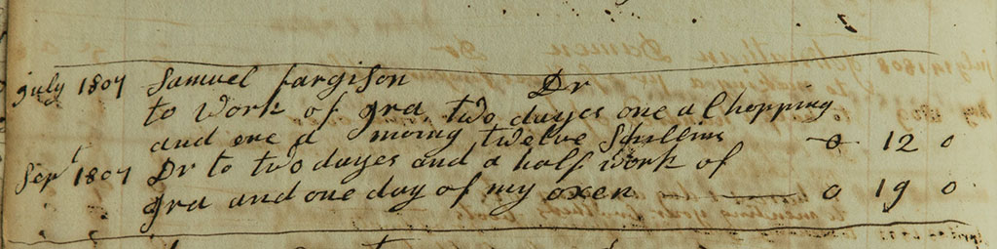
(“July 1804: Samuel fargison D[ebto]r to Work of Ira two days one a Chopping and one a moing twelve shallins”.)
The musical portions of the manuscript were all created thirty miles away, though—in Ellisburg. It is unclear why John DeCasterer left his prosperous sawmill to move closer to Lake Ontario around 1831. One possibility regards his daughter Cynthia, who married a Jefferson County man named Elijah Spink around 1782. Cynthia died in Ellisburg in 1812 and, a year later, Elijah “disappeared […] and was not heard from again.” Biographical data on the Spink children is extraordinarily scant, but at least one was still young when orphaned, and two married just as John DeCasterer moved to Ellisburg. Perhaps the children had been in the care of other members of the Spink family, giving the Casters an ongoing kinship link to Jefferson County. Although they kept separate households, Ira, his wife, and children moved to Ellisburg along with his parents, while all the other siblings either remained in Oswego or went further afield to the Upper Midwest and Canada. John continued to use the account book to record transactions in both Redfield and Ellisburg.
Caster Family Residences: 1770-1831:

Although the amount of biographical data available about the Caster family is substantial, there are still blanks. Ira’s writings indicate that he was a devoted Christian, but none of the family had known religious affiliations during the nineteenth century. Lucretia Richards Custover had her son baptized as a child at a Congregationalist church— but that was in the 1750s. The family would have had the chance to attend Congregationalist worship in western New York had they wished, as fellow Connecticuters established a society in Redfield in 1802. The hymn that texts Ira records are fairly ecumenical, though some of the most distinctive are of Baptist origin. Again, Ira would have had the opportunity to join a Baptist congregation, either in Ellisburg proper or in the villages of Mannsville and Belleville. Most surprisingly, Ira was demonstrably fond of high-church Anglican devotional literature. Although it was not uncommon for people to join a church even if they could not attend regularly, it seems that remoteness discouraged the Castors from seeking membership. In an 1832 pension application, John reported: “There is no Clergyman residing in the town of Redfield nor nearer than ten miles of [my] place of residence.”2
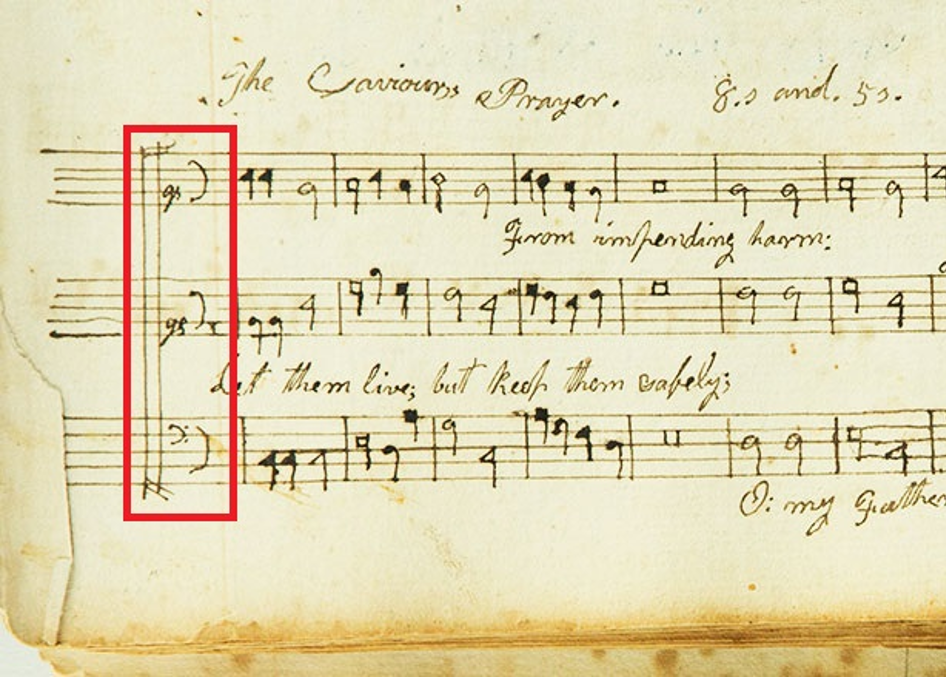
Even more obscure is Ira’s education, general and musical. The first known school session that he could have attended without significant travel was taught by Redfield’s Congregationalist minister in 1802. Information on musical activities in the area are even scanter. Singing schools may well have been held in Oswego or Jefferson Counties, but records are slim even for the regional cities of Utica and Rome. The earliest recorded school accessible to the Castors—held in Watertown, connected to Ellisburg via lake traffic—was held in 1859. A meager piece of evidence that Ira studied music earlier in life is his predilection for notating music in retortive time. This mood of time began to be omitted from many tunebooks during the 1820s, suggesting that Ira learned to read and write music before that time—or from a particularly old-fashioned teacher. He may have simply learned music-reading within his own family; a 1910 account recalls his father as “an educated man […] reputed as a poet and musician.”3 Ira himself could well have served as a precentor, chorister, or choir member.
Use of “Retortive” Time Signature to Indicate the Third Mood of Common Time in SAVIOUR’S PRAYER:
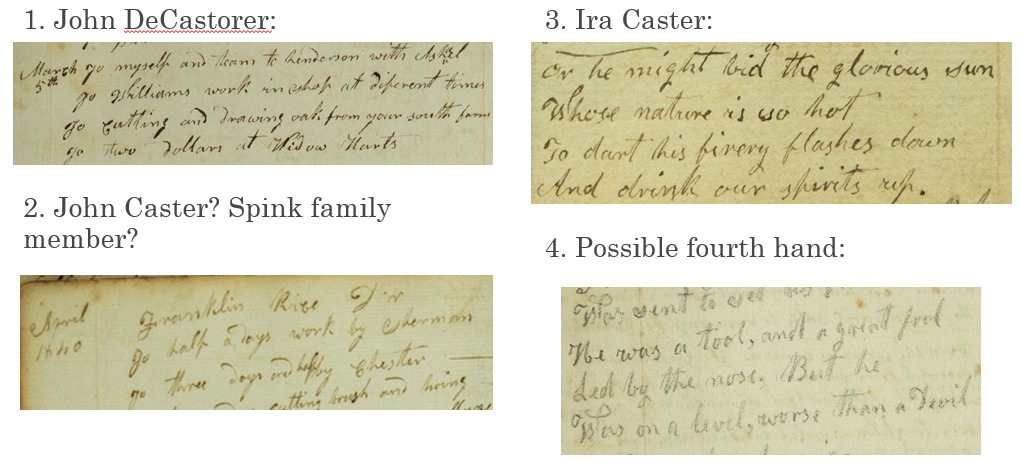
There are at least three or four hands represented in the account book. John DeCastorer was the principal hand up to his death in 1835. After this, accounts began to be kept in another hand, though it is unknown if they were created in Ellisburg or Redfield; depending on location, Ira’s oldest brother John Castor or one of the Spink nephews are likely candidates. The last dated accounts are from 1841, after which the manuscript fell into Ira’s hands. He began to use the remaining blank spaces like a commonplace book, recording newspaper articles, medical advice, and song lyrics. Yet some of the lyrics added in the post-account-book era are in a much larger hand than Ira’s typical script and are written in pencil, colored ink, or crayon rather than the plain ink Ira favored. Much of the material in this possible fourth hand is thematically similar to that definitely written by Ira, which suggests that it may also have been written by him—just more sloppily than usual, and perhaps at a later date. Or it may be that the account book was used for its spare paper by some other person who also had an interest in music—in their case, contemporary secular music. The latest datable passage in the manuscript, written in or after April, 1865, is in the “fourth” hand.
Hands in the Manuscript:
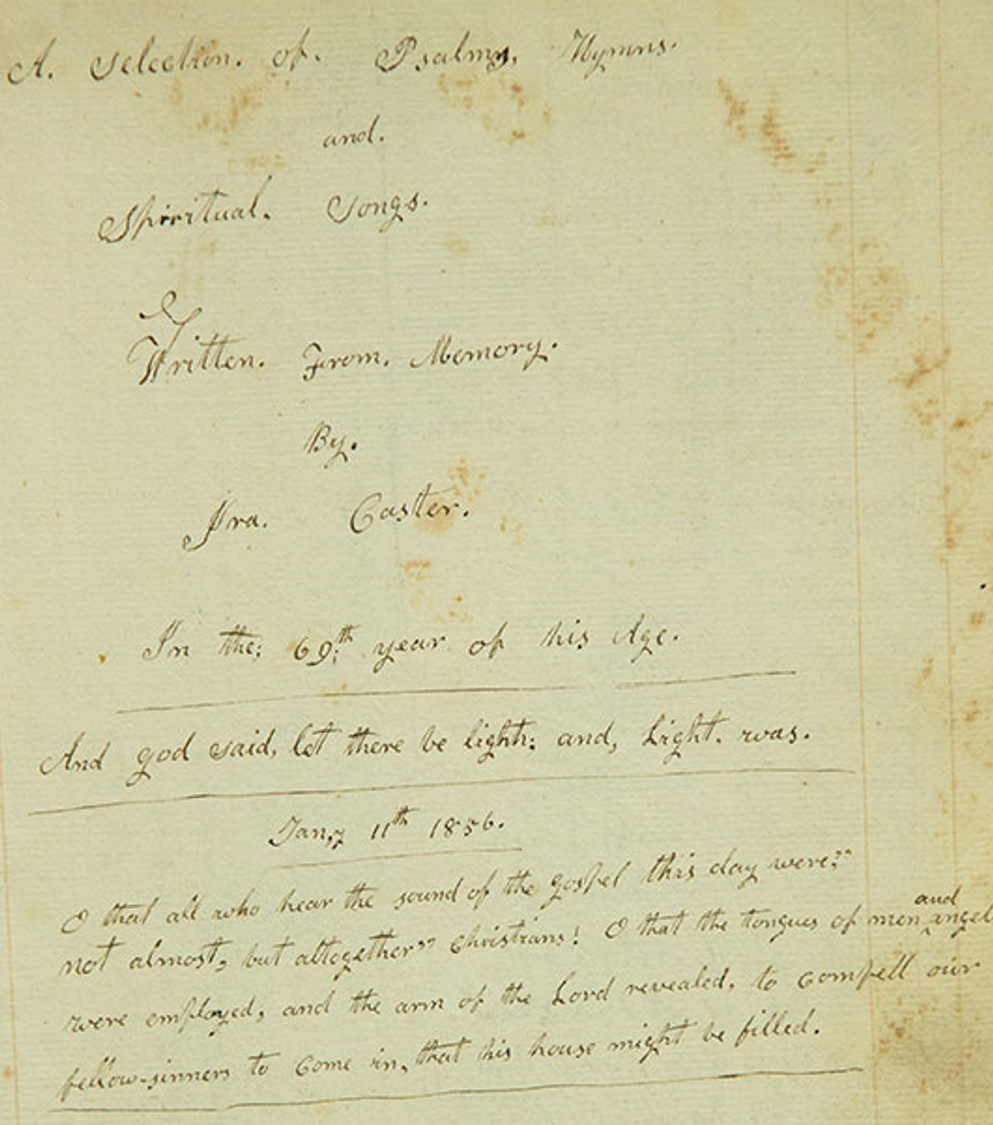
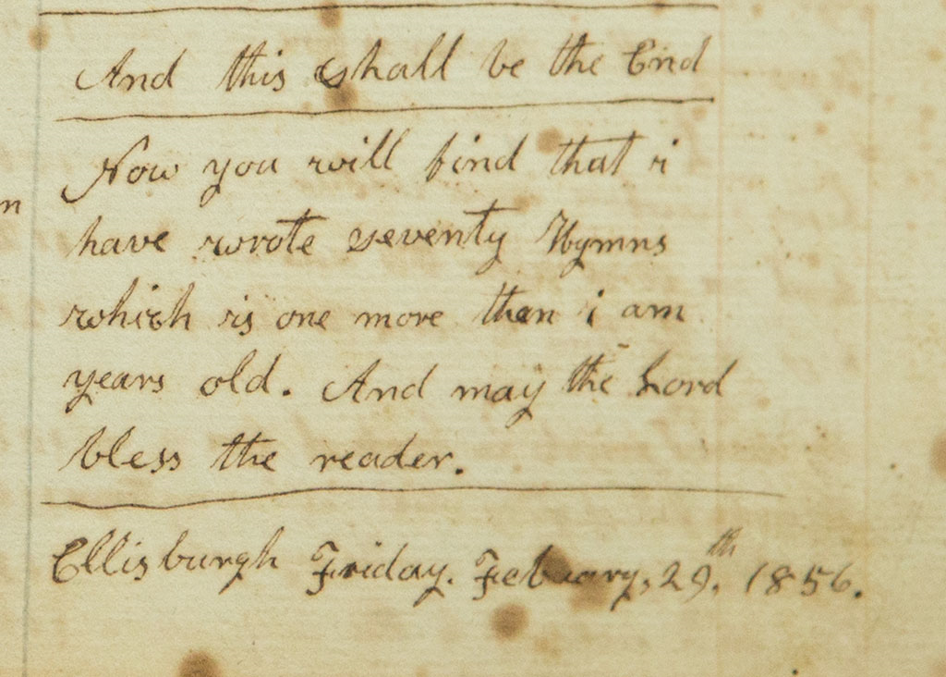
The central musical contents are introduced with a title page: “Psalms, Hymns and Spiritual Songs Written from Memory.” An extended selection of hymns follows. Unlike many of Ira’s contributions to the manuscript, these are written neatly on pages that had previously been blank. The earliest dated text was copied on 16 December 1855. By late February, Ira had concluded his project, declaring “And this shall be the End.” He reckoned the total number of hymns copied at seventy—“which is one more than I am years old”—and provided the selection with an index. Yet Ira soon expanded the project, eventually transcribing exactly 101 hymn texts. Dated items reveal that he passed back over the pages several times, identifying pockets of blank space in which yet another hymn could be written. The latest passage is from 1860.
Title Page of the Hymn Selection:
“End” of the Hymn Selection:
Index to the First Seventy Hymns:
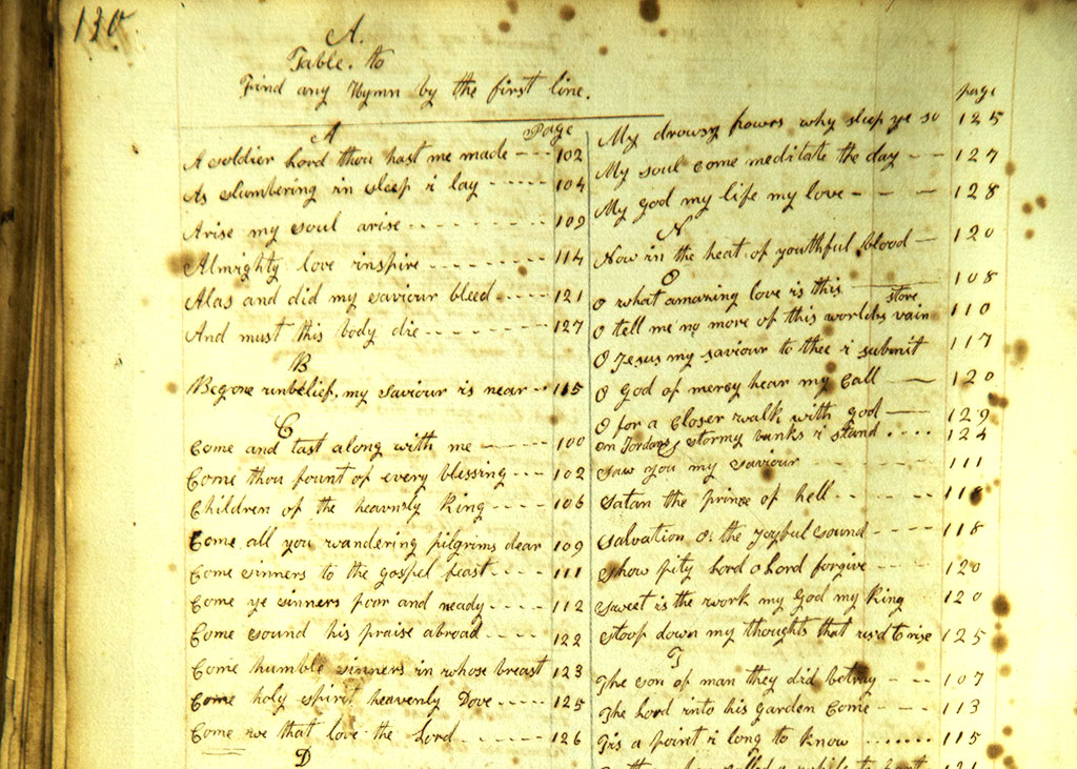
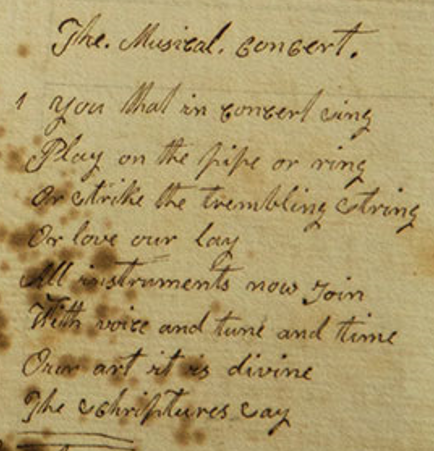
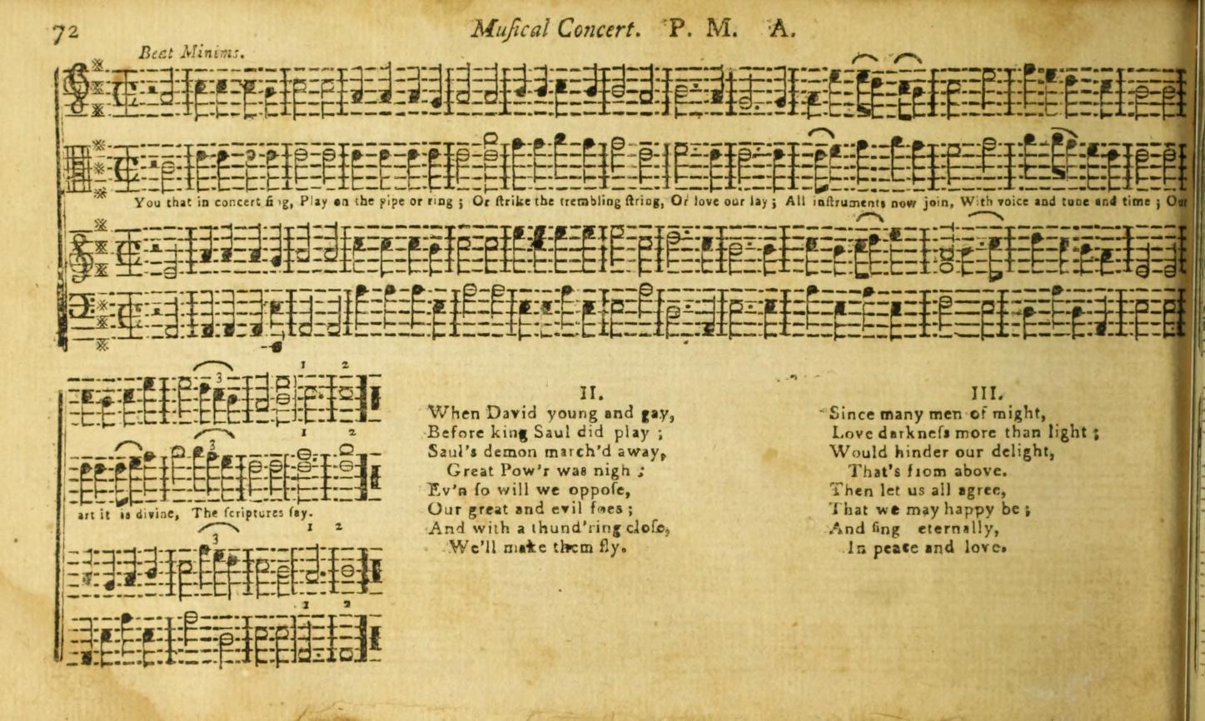
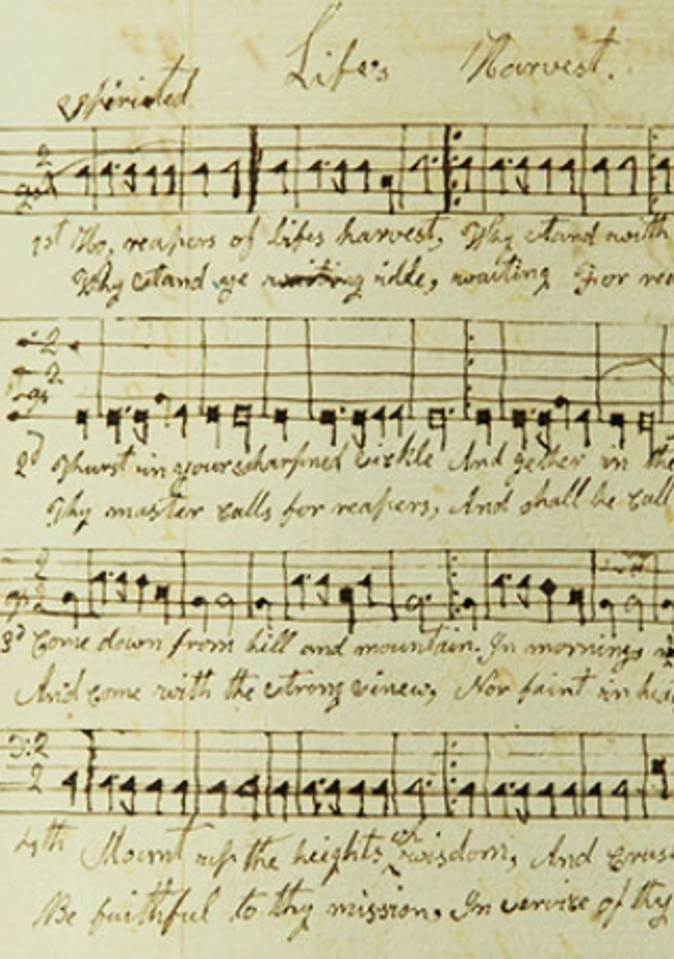
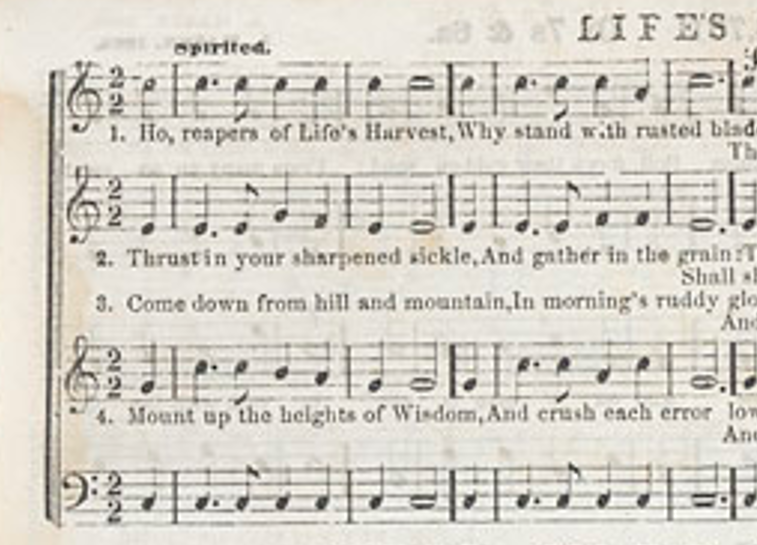
This section contains only hymn texts. All of the tunes instead appear earlier in the book, interspersed with the account-book entries. None of them are dated, but they seem to have been written roughly concurrently with the hymns: tunes and texts deliberately complement each other, with almost every text attached to a tune being continued in the hymn section. The selections demonstrate Ira’s acquaintance with print sources of varying date and type. One text is a hymn about sacred music, only attested elsewhere in Harmony of Harmony, a tunebook that Jacob French published in Northampton in 1802. This very rare hymn is the only item in the manuscript that conclusively linked to Harmony of Harmony. Yet Ira does transcribe the tune found in Harmony of Harmony, nor does he provide a different tune for the hymn, nor does any tune in the manuscript match its meter. LIFE’S HARVEST is one of the few tunes reproduced without change from a printed source—even employing a 4/4 time signature instead of retortive time. In this case, that source is The New Lute of Zion, where the composer first published it in 1856. Few items in the manuscript are so evidently indebted to a particular source, yet these two examples express the breadth of material Ira considered worthy of copying (and, presumably, memorizing). One text was published in outside of the region during his childhood; the other would not have been not available until he had already begun transcribing hymns.
“The Musical Concert,” Caster MS:
THE MUSICAL CONCERT in Jacob French, ‘Harmony of Harmony’ (1802):
LIFE’S HARVEST, Caster MS:
LIFE’S HARVEST in I. B. Woodbury, ‘The New Lute of Zion’ (1856):
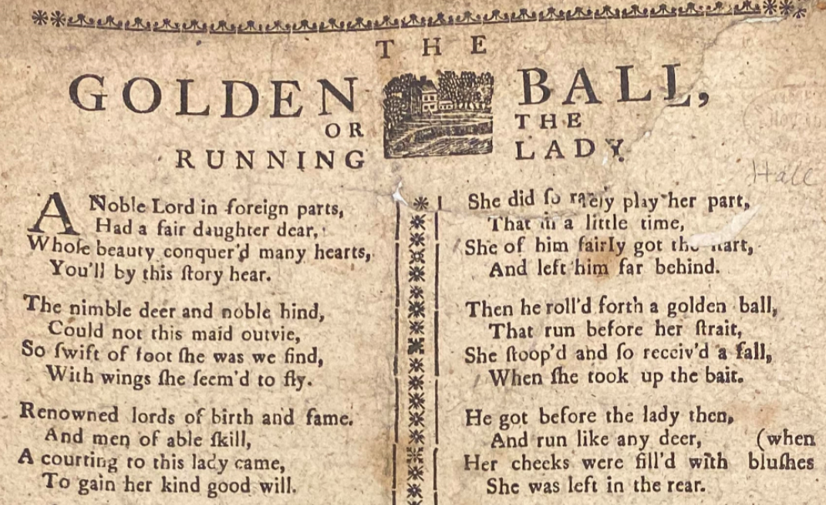
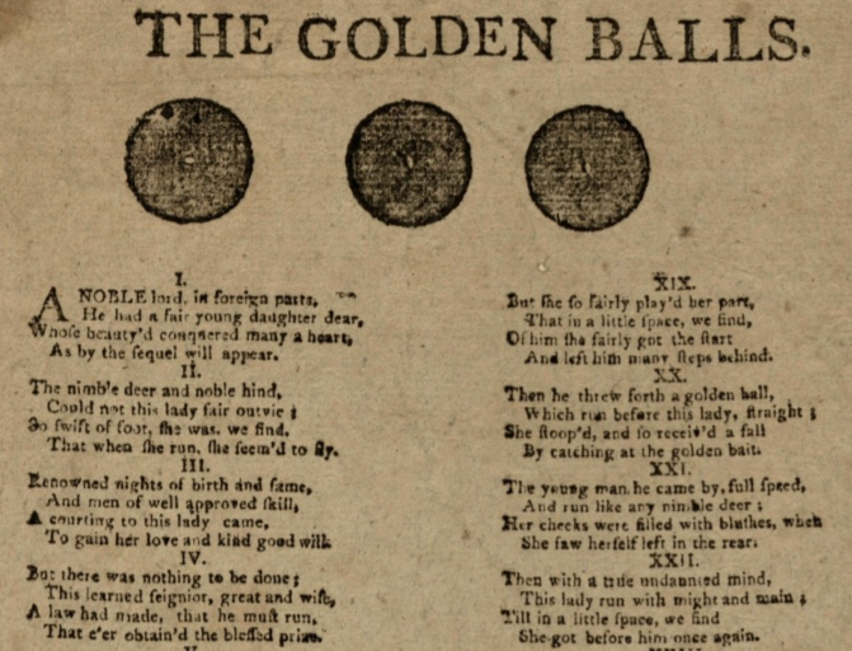
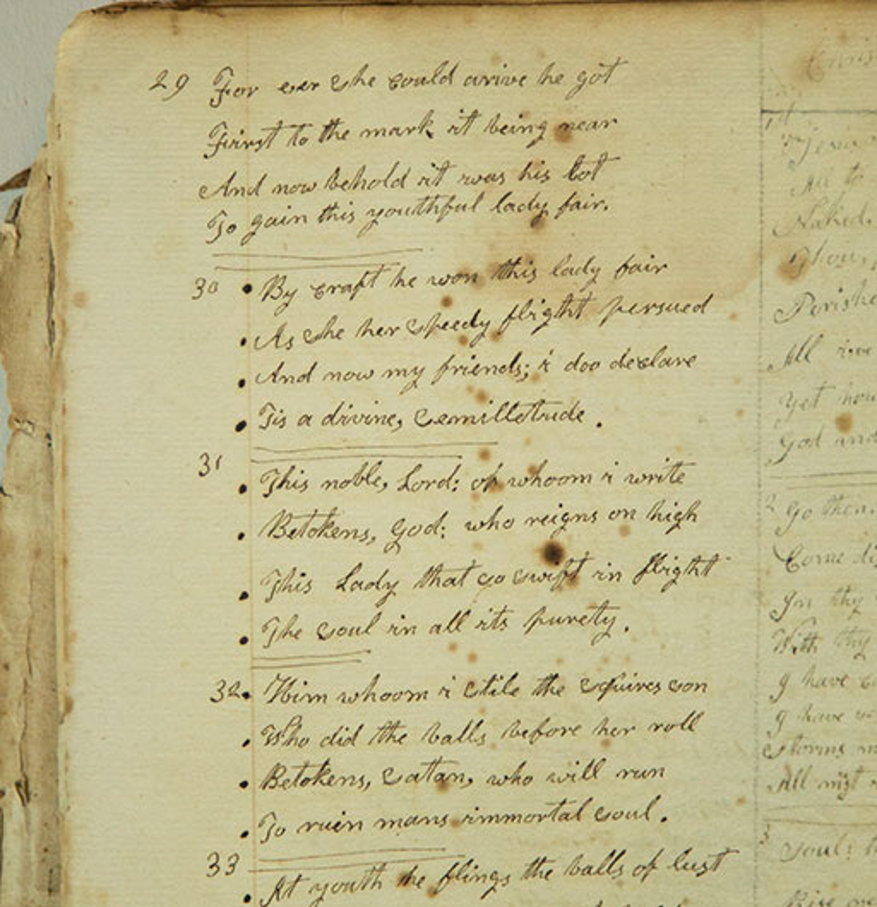
Although he described his collection as consisting of “Psalms, Hymns, and Spiritual Songs,” some selections stretch the definition of “spiritual.” The anonymous text “All o’er in sin defiled,” though religious in nature, was published as a piece of literary poetry in several newspapers in late 1859. Given the hymn’s unusual meter and its absence from hymnals or tunebooks, the tune Ira provides for it is most likely an original composition. The text of THE GOLDEN BALLS is known from two eighteenth-century broadsides. The earlier of the two, published in Salem in the mid-1770s, is a secular narrative about a footrace between a man and a woman, which he wins by distracting her attention by throwing golden balls. The version published in Rutland roughly twenty years later is almost identical—except for its last few stanzas, which frame the preceding story as a religious allegory. In the Salem version, the young man is applauded for his cleverness in winning the race; in the Rutland version, he is revealed to be a representation of Satan. Ira’s version—which, though slightly abbreviated, otherwise corresponds to the Rutland broadside—draws attention to the text’s debatably sacred nature. At the conclusion of the narrative, he changes the amount of margin and begins placing a dot next to each line, visually marking off the final allegorical section. Perhaps Ira was acquainted with secular and sacred versions; perhaps he initially forgot to add the allegorical verses.
Broadside “The Golden Ball or the Running Lady,” Salem, MA, ca. 1772:
Broadside “The Golden Balls,” Rutland, VT, ca. 1797:
Conclusion of “A noble lord in foreign parts” in Caster MS, showing “seam” at beginning of religious explanation:
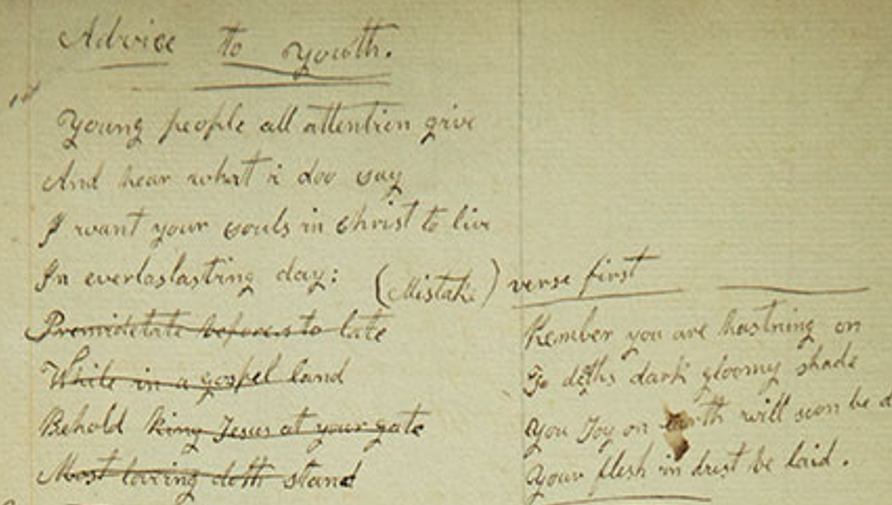
Ira typically selects hymns attested in print sources and copies versions that adhere very closely to published ones. There are occasional instances of flawed recall—most often alterations of vocabulary that do not interfere with meaning or meter. Errors of which Ira was aware are invariably crossed out and rewritten. Despite their rootedness in literate repertoires, most texts cannot be traced to individual sources because they were so widely disseminated. One hymnal that includes some of the more obscure hymns and which may have been accessible to Ira was Schuyler Stewart’s Canadian Minstrel, published in Hamilton, Ontario in 1854—which still includes only a fraction of the hymns Ira copies.
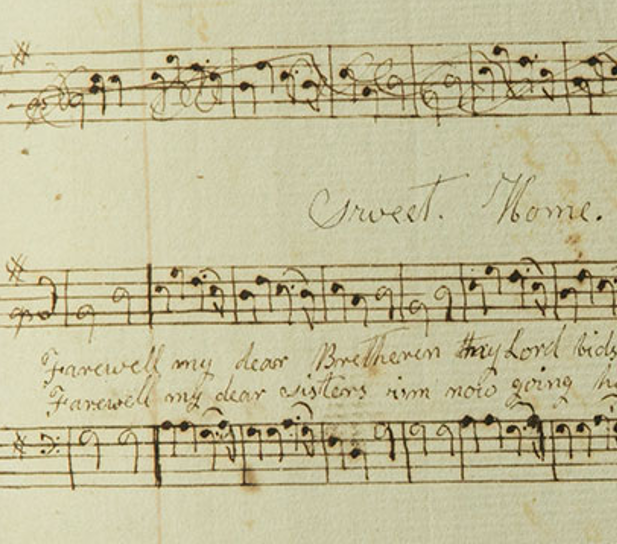
Rhythm/accent incorrectly notated:
Incorrect order of verses:
When he does seem to have been guided by a published work, it was one more popular than The Canadian Minstrel. Numbers 55 through 67 of the “original” seventy hymns all from books one and two of Isaac Watts’s Hymns and Spiritual Songs. These texts were widely sung and republished in the mid-nineteenth-century. All but two of the selections in this passage follow Watts’s numbering. More so than any other part of the manuscript, this section calls into question Ira’s claim (or goal?) to have written from memory. Since Watts’s hymns were commonly referred to by book and number, it is not impossible that a person very familiar with them might be able to recall twelve of them in near-perfect order without reference to a hymnal. The more plausible explanation is that Ira was struggling to think of additional hymns to round out his planned number of seventy, so he referred to a copy of Hymns and Spiritual Songs, flipped through it in order, and transcribed the ones he liked. It cannot be conclusively stated that he wrote them from memory, but it does seem likely. A small discrepancy appears in “Now in the heat of youthful blood”: instead of “creator God,” Ira writes “creative God.” This rendering, while perfectly semantic, is not attested in any known printings of the hymn. The substituted word was probably a slip of the memory.
Sequentially Transcribed Texts from Watts’s ‘Hymns and Spiritual Songs’ (1707):
| Hymn Incipit (as Given in MS) | Watts’s Numbering |
| Now in the heat of youthful blood | Book 1, no. 91 |
| My drowsy powers why sleep ye so | Book 2, no. 25 |
| Stoop down my thoughts that used to rise | Book 2, no. 28 |
| Come Holy Spirit heavenly Dove | Book 2, no. 34 |
| Come, we that love the Lord | Book 2, no. 30 |
| Why should we start and fear to die | Book 2, no. 31 |
| Is this the kind return | Book 2, no. 72! |
| My soul come meditate the day | Book 2, no. 61 |
| Hark! from the tombs a doleful sound | Book 2, no. 63 |
| When i can read my title clear | Book 2, no. 65 |
| And must this body die | Book 2, no. 110! |
| My God, my life, my love | Book 2, no. 93 |
| How can i sink with such a prop | Book 2, no. 116 |
Texts Not Attested Outside the Caster MS:
| Let them live; but keep them safely; From impending harm |
| Come my blessed Saviour, long has been thy stay O revive us quickly or our foes will say* |
| Whats this that steals upon my frame Oh tell me is it death [Common Meter] |
| Come all you lovely youth thats called to mourn For: that one blooming youth now dead and gone* |
| How easy it would be with god To arm his dreadfull cold |
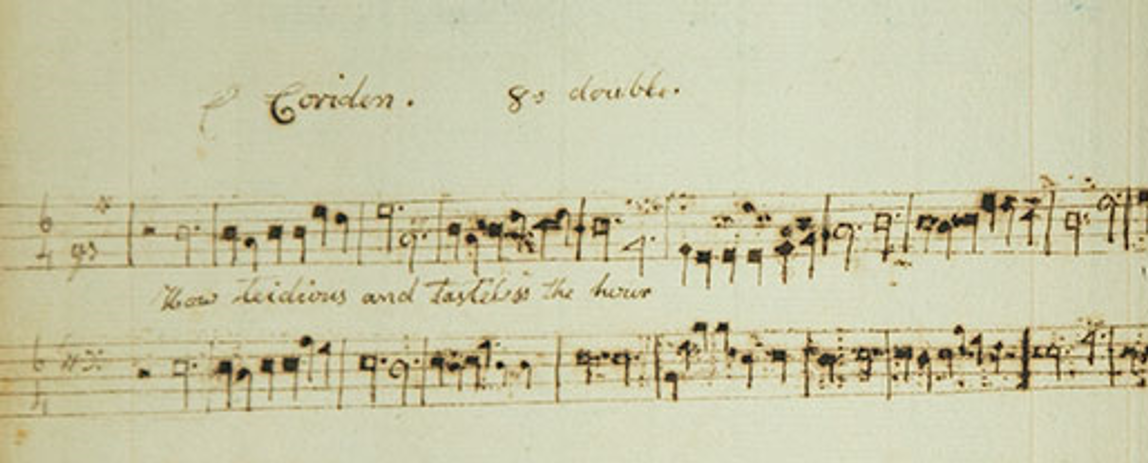
The tunes are a very different case. Only 9% of them can be traced to a specific arrangement. 15% bear some similarity, often distant, to published tunes. 7% belong to a known tune family, but do not correspond to any individual tune attested elsewhere. And the majority—just shy of 40%—have no known analogues in the published repertoire or in manuscripts indexed in SWASMIS or AVMM. Only four out of the forty-four tunes have titles attested in any other source; most simply bear names derived from the hymn Ira pairs with it. Yet he was not wholly ignorant or forgetful of common tune names, as exemplified by the case of CORIDEN. This tune is usually known as PASTORAL ELEGY and paired with the text “What sorrowful sounds do I hear?” Although Ira sets it to a popular John Newton hymn instead, his title derives from the original lyric “Sweet Corydon’s notes are now o’er.” Ira had strong notions of the “correct” version of a melody, demonstrated by the occasions on which he makes and then repairs a “mistake” that is as similar to other renderings of the tune as his “non-mistakes.” Almost all of the accompanimental parts, though, are newly composed. It seems highly unlikely that Ira was copying directly from a print source for all but four of the tunes. Despite his facility with notation, he may never have encountered them in print at all; if he did, he certainly felt no obligation to preserve the specific arrangement or paratext he encountered.
CORIDEN, Usually Including the Lyric “Sweet Corydon’s notes are all o’er”:
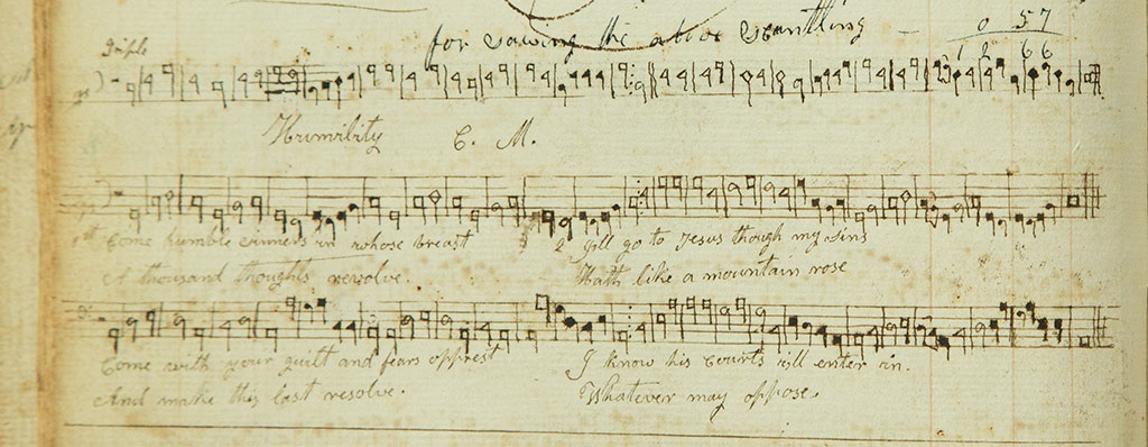
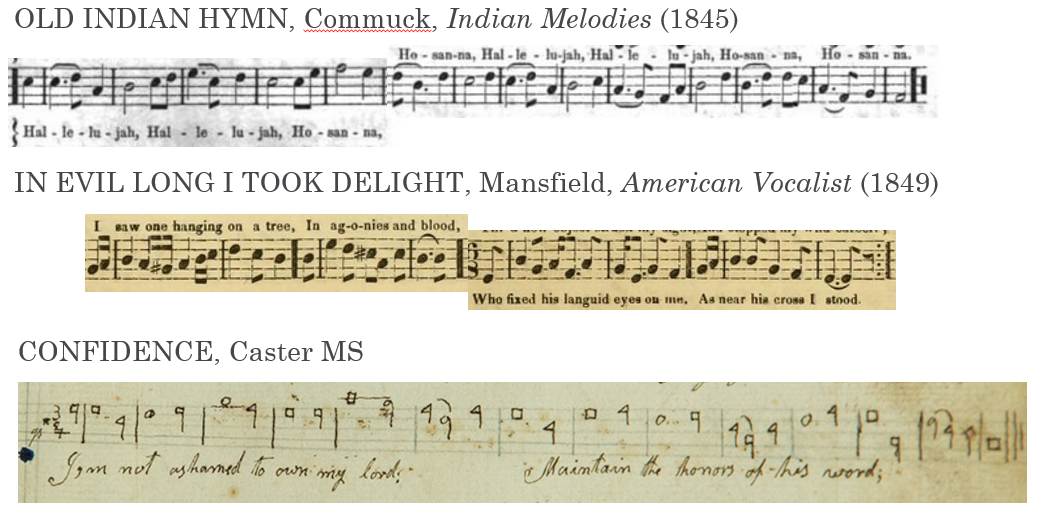
As for the numerous unidentified tunes: some are probably original compositions, others folk hymns that never got transcribed elsewhere. Some of Ira’s tunes are demonstrably part of folk hymn families. He includes two different versions of the popular tune FIDUCIA that feature variant rhythmic patterns and almost unrecognizably distinct arrangements. (Who knows if he recognized the two as related!) Both of the texts he selects are unusual, although one would be printed with a FIDUCIA variant in a folk-hymn-heavy songster published in Troy three years after Ira died. This suggests that this tune/text combination may have been heard in the area and that Ira was the first to record it. Another tune that was likely part of the folk repertory in western New York is the one Ira calls CONFIDENCE. It is known in two variably realized print versions: Thomas Commuck’s 1846 Indian Melodies and D. H. Mansfield’s 1849 American Vocalist. Commuck’s printing recounts a legend that Narragansetts had heard this melody “in the air” for centuries and were surprised to hear Euro-American Christians singing it in Plymouth. Christianized Narragansetts were gifted a tract of land in Marshall by the Oneida Nation in the early 1780s; Commuck lived there at one point. Marshall lies directly opposite Rome from Redfield. Commuck’s story implies that the tune was known to non-Native Christians in New England. Ira’s variant, transcribed less than a decade later and seventy miles away, strongly implies that Euro-Americans also sang it in western New York.
HUMILITY, Variant of FIDUCIA, with Same Text as Hillman and Hartsough, ‘The Revivalist’:
A Small Tune Family:
Ira was evidently a literate (and music-literate) person who could take advantage of printed collections. So why did he prefer to copy from mind to manuscript rather than page to page? Although pedagogical theories shifted significantly across his lifetime, Ira would have been raised in an intellectual culture wherein memorization was a desirable and explicitly literate skill. Reading permitted a scholar to learn a text for the first time. Memorization allowed him to manipulate it with increased facility. Hence the maxim, often repeated in primers: “Speak from the book as though without it.” Bounded by rhyme and meter, hymns were easy to memorize and, unlike secular poetry, implicitly moral. The common-school reader used in nearby Cape Vincent in the 1850s and ’60s cautioned students to “beware of bad books, because principles imbibed and images gathered from them, will abide in the memory and imagination forever.”4
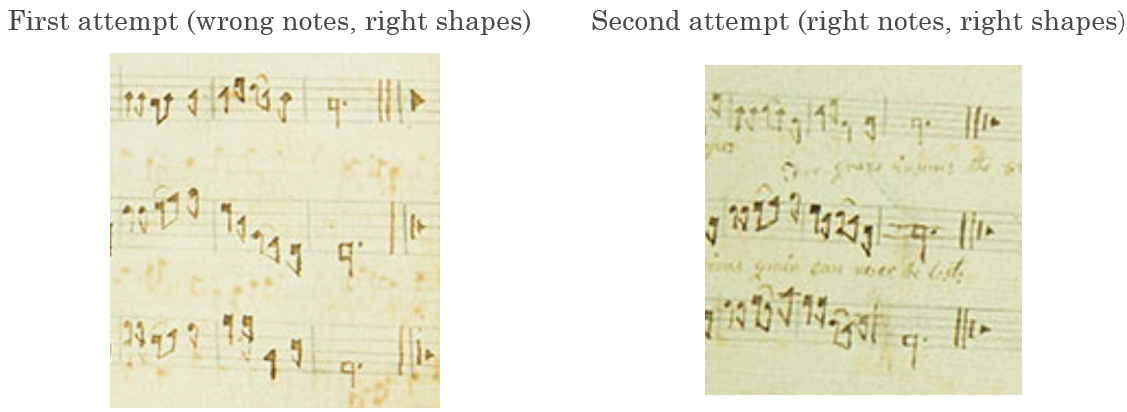
The Caster account book stands apart from many contemporaneous sacred music manuscripts because it is not a tool for learning, but a demonstration of completed learning. Rather than creating a partbook of new repertoire, or including a gamut for repeated study, Ira displays his mastery over the material he is copying. This is particularly evident in his treatment of notation. Because he so rarely referred to notated copies, even when they were demonstrably available to him, he had to transcribe each tune anew, making sensible decisions about key, time signature, etc. This is the type of notational facility that W. C. Woodbridge marveled at when encountering children who could “write music, not from dictation only, but from original conception.”5 The other voice parts, composed more than transcribed, also exemplify completed study: though Ira’s partwriting is far removed from the “scientific music” popular at midcentury, its style is internally consistent and, by that measure, successful. Most are written in four-syllable shape notation, while a minority are in round notes. Ira demonstrates a facility with both. His most dramatic notational mistake—which led him to erase half of his first try at notating a GUILDEROY variant—resulted from him misremembering an interval in a cadential figure. Even though he wrote the wrong notes, the shapes he assigns to them still correspond to the correct scale degrees.
Final Cadence of ASSURANCE:
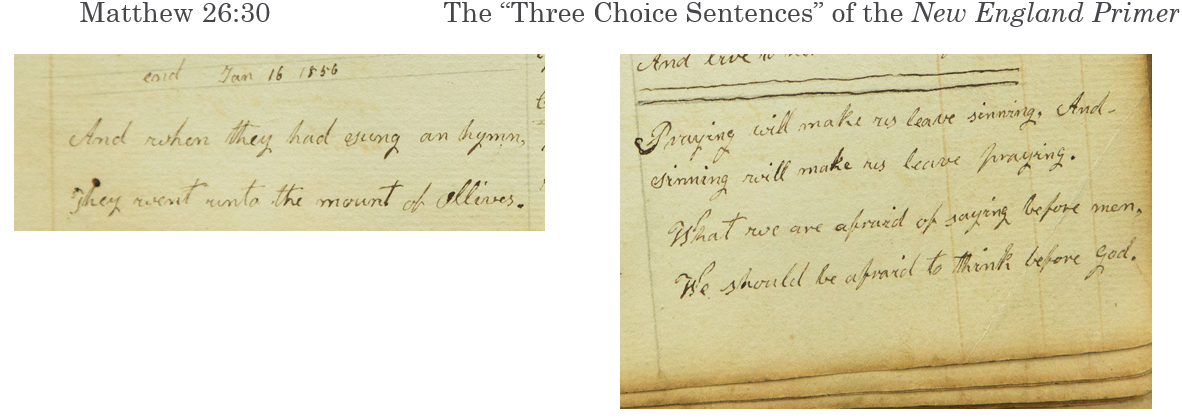
Perhaps even more importantly in the context of sacred music, memorization might be a means of grace. Memory had long been central to Protestant interactions with scripture, hymns, catechisms, and devotional literature. Children memorized hymns before they even began to learn Bible verses, a longstanding practice increasingly systematized through Sabbath schools in the 1810s and ’20s. Scholars in Cazenovia, New York recited a cumulative 10,197 Bible verses and 1,187 strophes of hymns during their 1819 examinations. Those who were particularly successful would be rewarded with premiums, such as a handkerchief or mug emblazoned with yet another hymn—or, in a case reported in Jefferson County in 1850, tickets to a singing school. The ability to memorize signified the learner’s diligence and piety as well as the support of God. Numerous obituaries record the decedents’ successful recitation of hymns despite extremity of youth, age, or illness. Twenty-nine-year-old Samantha Barber died in Fenner, New York in 1849. She had suffered from epilepsy throughout her life, which gradually eroded her mental faculties. Yet, “notwithstanding her impaired intellect, day after day would she sit and repeat whole chapters of scripture, and hym[n]s which she had committed to memory.”6 Similarly, the ability of a precentor or chorister to spontaneously select an appropriate hymn was often acknowledged as the favor of the Spirit.
Ira Caster’s devotional memorization encompassed Bible verses, religious aphorisms, and extensive excerpts from the 1763 Compleat Duty of Man, all found scattered through the manuscript. One indication of devotional memorization (and facility of recall) is his assignment of hymn texts to tunes. Certain texts seem to have held particular spiritual meaning for Ira, and these are the ones that he repeats again and again. Verses of “My soul’s full of glory” and “Come and taste along with me” are paired with three different tunes each. Moreover, he had a sufficient supply of texts to recollect an extremely obscure hymn about God’s control over the weather when looking for something to copy on January 10th, 1856, “a cold stormy day.”
Devotional Texts in the Caster MS:
Finally, memorization was a grounding for creative work executed via recontextualization and transformation. Like many aspects of memorization pedagogy, this notion derives from medieval and early-modern educational practice, in which the memory was seen as a storehouse for expressions that could be deployed to enrich the student’s own ideas. Scholars of oral repertoires have noted the culturally specific nature of “verbatimness.” Ann McLucas wrote that recollection of a melody will vary depending with “the general memory capacity of the individual and even of his or her culture is—that is, what the expectations are for accurate memory.”7 She concluded that oral traditions do not value a “fixity of text.” Literate ones need not either. Many discrepancies between nineteenth-century music manuscripts and their (aural or written) sources are explicable not as failures of memory, but deliberate interventions to a remembered text. Some changes are simple “localizations” suiting a song to its current context, as when Rochester’s first common-school music textbook changed “Flow Gently, Sweet Afton” to the more regionally appropriate “Sweet Croton.” Ira intervened on remembered objects most explicitly in the non-musical sections of the manuscript. Similar, however, is the hymn that John Caster wrote in memory of Polly Mosier and which Ira put to paper after having “had [the verses] in his head 58 years.” And the transformation of the popular hymn “What’s this that steals upon my frame?” from particular meter to Common, known only from this manuscript, may well be Ira’s work, too.
Note on “Come all ye lovely youth that’s called to mourn”:
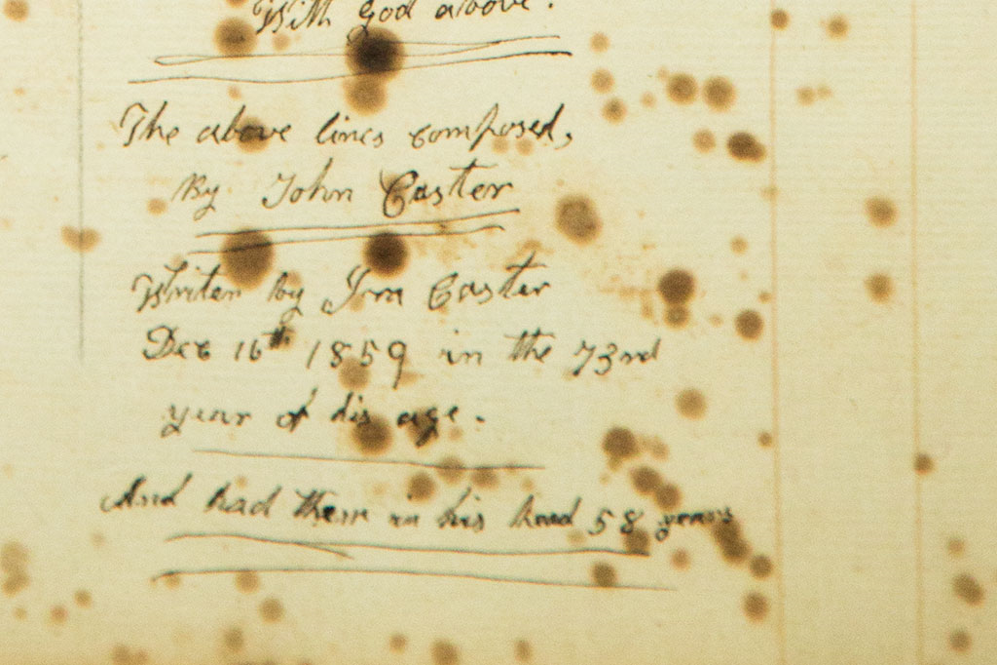
(“The above lines composed, By John Caster | Written by Ira Caster Dec. 16th 1859 in the 73rd year of his age. | And had them in his head 58 years”.)
Recent scholarship has correctly emphasized the indebtedness of sacred music manuscripts to print culture. Yet some of the discrepancies or unlikelihoods of manuscripts are not rooted in print at all. People—even musically literate people—did not always store texts and tunes on paper, but might rely on the more malleable inventory of the mind. The Caster family account book includes a text that Ira first memorized around age thirteen, and another at seventy-one. Though he explored print sources, he did not consume them passively. After all, he had developed his qualifications as a copyist in culture wherein the written word (and note) was routinely memorized, recalled, and transformed.
Sources for Quotations
1 David C. Rubin, Memory in Oral Traditions: The Cognitive Psychology of Epic, Ballads, and Counting-Out Rhymes (Oxford: Oxford University Press, 1995), 3.
2 John DeCastorer, testimony from 1832 pension application, document S.12423, National Archives; trnscribed in “John Castor: Revolutionary War Soldier of New York,” The News-Caster 2, no. 2 (June 1984): 11.
3 Henry A. Jean Castor, The Castors of Castorland: The Descendants of John DeCastorer, an Ensign in the Revolutionary Army, Who Settled in Redfield, New York, after the War (Philadelphia: Martin & Allardice, 1910), iv.
4 J. Russell Webb, Webb’s Normal Reader no. 4: Designed to Teach Correct Reading, Improve and Expand the Mind, and to Purify and Elevate the Character (New York: Sheldon and Company, 1860), 111.
5 William Channing Woodbridge, quoted in Juanita Karpf, “‘Would That It Were So in America!’: William Bradbury’s Observations of European Music Educators, 1847-49,” Journal of Historical Research in Music Education 24, no. 1 (October 2002): 25.
6 “Died,” Madison County Whig (Cazenovia, NY), Oct. 10, 1849: 2.
7 Ann Dhu McLucas, The Musical Ear: Oral Tradition in the USA (Burlinton, VT: Ashgate, 2010), 65.
Selected Secondary Sources
- Castor, Henry A. Jean. The Castors of Castorland: The Descendants of John DeCastorer, an Ensign in the Revolutionary Army, Who Settled in Redfield, New York, after the War. Philadelphia: Martin & Allardice, 1910.
- Davenport, Linda G. “American Instruction in Sight-Singing: Then and Now.” Journal of Historical Research in Music Education 13, no. 2 (July 1992): 90–111.
- Dellow, Rebecca E. “‘Who Were the Folk?’: The Compilers of Nineteenth-Century Manuscript Tunebooks.” Folk Music Journal 11, no. 3 (2018): 6–31.
- Densmore, Christopher. “Understanding and Using Early Nineteenth Century Account Books.” Archival Issues 25, nos. 1-2 (January 2000): 77–89.
- Densmore, Christopher, and Laura Densmore. “Ira Caster (1787–1867): An Upstate New York Composer in the Shape Note Tradition.” The News-Caster 11, no. 2 (June 1993): 23–24.
- Grindal, Gracia. “Writing Hymns and Singing Them—Memory and the Oral Culture: Some Reconsiderations.” The Hymn 70, no. 1 (Winter 2019): 24–29.
- Gruhn, Wilfried. “European ‘Methods’ for American Nineteenth-Century Singing Instruction: A Cross-Cultural Perspective on Historical Research.” Journal of Historical Research in Music Education 23, no. 1 (October 2001): 3–18.
- Hash, Phillip M. “Music at the Illinois Asylum for Feeble-Minded Children, 1865–1920.” Journal of Historical Research in Music Education 32, no. 1 (October 2010): 37–56.
- Heller, George N., and Carolyn Livingston. “Lowell Mason (1792–1872) and Music for Students with Disabilities.” Bulletin of Historical Research in Music Education 1, no. 16 (September 1994): 1–16.
- “John Castor: Revolutionary War Soldier of New York.” The News-Caster 2, no. 2 (June 1984): 8–11.
Karpf, Juanita. “‘Would That It Were So in America!’: William Bradbury’s Observations of European Music Educators, 1847–49.” Journal of Historical Research in Music Education 24, no. 1 (October 2002): 5–38. - McLucas, Anne Dhu. The Musical Ear: Oral Tradition in the USA. Burlington, Vt.: Ashgate, 2010.
- Phillips, Christopher N. The Hymnal: A Reading History. Baltimore: Johns Hopkins University Press, 2018.
- Rubin, David C. Memory in Oral Traditions: The Cognitive Psychology of Epic, Ballads, and Counting-Out Rhymes. Oxford: Oxford University Press, 1995.
- Schweiger, Beth Barton. A Literate South: Reading Before Emancipation. New Haven: Yale University Press, 2019.
- Volk, Terese M. “Rote Song Books: Materials and Repertoire for the Classroom, 1846–1850.” Journal of Historical Research in Music Education 17, no. 3 (May 1996): 181–196.

